GOLDEN ROCK JPEG005

GOLDEN ROCK JPEG005
It`s HUGE!!!

Monday, April 4, 2011

The Death of an Orange Sapphire

It was virtually the last piece of fax paper to roll out of the machine, striped with red edges, the end of the roll.
Since we were moving to a new house the next day, there was no use to put a new roll in the machine now. We would have a new phone number, and there is no such thing as a tape-recorded referral number in Bangkok. My old friend Dharmaratna in Sri Lanka, had he sent the fax just a few hours later, would not have been able to reach me. It had been five years since I had seen him, although I had briefly been in Sri lanka a year before, in 1996, shortly after the Tamil Tigers had blown up the Central Bank in Colombo, killing scores of people. I had had a specific job on that trip to deliver money and to pick up stones, I called nobody.
The fax read: "Urgent, there is a rare gem piece with me. Please contact me or my son immediately". I called him right back and he laughed mirthfully as he described finding a large gem crystal with his own hands that very day. He said it was found in the rain-soaked earth of his mine near the mist-shrouded mountains of Balangoda in southern-central Sri Lanka.

It was an orange sapphire of over 400 carats-clean, bright, and a deep orange. He had not seen a piece like this in thirty years of mining, and I could sense the confidence he felt in his luck. Knowing how very rare such a piece was, I wanted to be a part of it. I flew to Sri Lanka.

When I arrived in Colombo, Dharmaratna came immediately to my hotel. In my room. I held the crystal, which was as large as a chicken egg, 425 carats in the rough, with three natural crystal faces from the original hexagonal six till evident, yet frosted as if alluvial and water worn. One side was a concoidal fracture that was glassy and allowed a transparent, if concave, window through which I could see into the interior of the stone. This view showed that the stone was quite clean with none of the inclusions such as 'strong silk' or 'liquid feathers' that could impede the passage of light and affect the brilliancy once it was cut. The few cracks that it did have on the surface did not seem to extend deeply into the crystal and could easily be removed by cutting. On one of the frosted faces there were three or four parellel lines of blue caused by minute traces of titanium remaining from when the stone was formed, but they were confined to the outer skin. The stone told an interesting geological history, confirming that it had not been treated in any way.
The color was tangerine orange. Although not the salmon reddish-orange of a sunset, called padparadscha, it was surely colored by a combination of chromium and a slight bit of iron. On first inspection, the shape of the crystal seemed to lend itself to a 'cushion' cut, losing a minimum of weight while retaining the maximum of brilliancy and luster. The table cut seemed obvious, being the largest surface and slightly rounded, leaving room for graceful 'shoulders' and crown facets. What could become the pavillion, the bottom of the stone, already had its angles present, as if they had been formed into the crystal by Nature.

The stone seemed like it was born to be a 'cushion'. However, cupping it between my thumb and fingers and viewing it down the side rather than through the open face, I could see I was wrong. The stone would display a richer orange and the body color could be multiplied by cutting the table in the opposite direction, although the yield would be smaller. I figured that it could be cut into a single piece of 120 to 140 carats. The potential was there to produce perhaps one of the world's largest orange sapphires.
Dharmaratna only dealt in rough stones, since he was a mine owner, but I thought that if a cutter could just open a face, I could better determine the ultimate color and clarity. This however presented new problems. The first was the problem of secrecy. Could we find a cutter who would not betray to other dealers the existence of such a rare stone? Another problem was that after the stone had been opened, Dharmaratna would see clearly what the stone would become, and would thus raise his price if it exceeded his expectations. Not opening the stone presented the danger of finding some inclusions that could not be seen in the rough. Buying rough stones is a gamble, but uncut is where the big profit is, as well as the big loss.
I decided it best to bring a buyer here to see the stone himself, in the rough, and have him decide what to do. the questions which remained were how large, how clean, how brilliant, and how much.      

Enter the buyers:

Teddy Doyle, and Australian  ex-SAS commando, married to the daughter of a high-ranking  Indonesian general, and Lee Wolf, who had a gem company in Bangkok called Pacific East Trading. Teddy had spent several years in Indonesia before moving to Thailand, where he met up with Lee. They decided to work together, and in 1997 formed a new company called the Opal Factory at Khao Yai, northeast of Bangkok, at the foot of some beautiful mountains near the entry to the national park there.
I found out later that the new company was financed by another Australian, a nerdy-looking guy named Max Green. Max, who I met several times at Pacific East Trading's office on Convent Road in Bangkok, turned out to have looted up to 20 million dollars from trust funds under his management. Of that sum, 10 million dollars was said to have been given to Teddy and Lee to run Pacific East Trading, the Opal Factory, and to purchase stones.
All of the stone-cutters and polishers at the Opal Factory were handicapped men and women in wheelchairs, and Paul Elmer, the manager, built modified three-wheeled motorcycles for each of them to ride to and from work. Teddy and Lee were very generous. As a practical joke, Teddy had imported real Australian road signs warning drivers of kangaroos, and put them up on signposts on the country roads around the Opal Factory and the national park. The local authorities never even noticed, and the signs weren't removed. Unsuspecting visitors to the area were fooled into thinking that wild kangaroos were hopping around this part of upcountry Thailand. For all I know, the signs are still there.
I called Lee from Colombo, and described the orange sapphire. Of course he was interested, he said, and was prepared to fly to Sri Lanka straight away to purchase the stone for cash.
Lee had his first chance to see the stone, and offered 25,000 dollars, eventually raising the bid to 40,000 after the first round of negotiation. Dharmaratna must have been disappointed with this bid, as he returned to Balangoda and called me later that afternoon, saying that he had found a buyer for 70,000. I asked him to return to Colombo immediately and to bring the stone with him. He asked me if there was really a reason to return, as the trip was a three-hour drive. I assured him that there was.
Calling him back again, he told me that a buyer in Ratnapura had offered him 90,000. Maybe he was bluffing, trying to drive up his price, but he knew we had cash and that we were scheduled to leave soon. His reluctance to return convinced me that he really did have that offer. I knew that if we did not get him back soon, the stone would be bid up beyond the gamble that we were willing to take.
Dharmaratna returned later that evening and Lee canceled his return flight to Bangkok. For four hours we negotiated back and forth and, exasperated, Lee finally bought the stone for an even 100,000 dollars. Later in a Chinese restaurant out of Lee's sight, Dharmaratna gave me 10,000 dollars.
What would happen now depended on what was inherent in the stone and the skill of the cutter.
                                                                           *
Lee and I returned  to Bangkok, where he and Teddy would decide what to do with the rough. They had paid for it, it was their stone and their decision.
Lee, who is not a gemologist, was convinced by somebody that the orange color could be enhanced by burning.
Burning a stone at a low temperature to remove 'silk' or to improve the brilliancy or color can be a way of completing Nature's process. It can also be a dangerous operation with unpredictable results. I cautioned them and said that, as it was, the stone would yield a flawless gem of over 100 carats and would be perhaps the finest of its kind in the world. My advice was ignored and they burned the stone.

The result was that the rich tangerine-orange was burned out, and what remained was a golden yellow-lemon. Rather than having a fabulous gem worth over a million dollars, they now had at best a 50,000 dollar stone.
Worse was to come later.
In the meantime, I joined up with a couple of Japanese gem-dealers to assist them in their buying. We bought large, sometimes  100 kilo boulders of jadeite, in Burma. These huge white-and-green streaked monsters were shipped to the Opal Factory at Khao Yai to be hollow drilled into long tubular seals which the Japanese, having the characters of their names etched in the bottoms, use to sign legal documents for real estate and banking transactions. They are called hanko. Some had a very fine medium emerald green color.

One afternoon in March 1998, I was with Teddy, waiting for a new batch of hanko to be polished by his workers, when his mobil phone rang. Max Green was dead. He had been murdered in Phnom Penh, Cambodia, in room 511 of the Sofitel Cambodiana. It was a very professional job. The hallway cameras had either been disabled or the film removed.Whoever had murdered Max was extremely angry. Stealing 20 million dollars would make many people angry. Max's head had been smashed completely. His gold Cartier watch, his cash, passport, credit cards were still in the room. Only his laptop was missing. He was so disfigured that he could only be identified by dental records. Later in Melbourne, by court order, he was exhumed to prove it actually was him. It was.

So who killed Max Green? Who knows?  I can say for sure that it was not Teddy Doyle, as the Australian press had suggested. I know because I was with Teddy at Khao Yai when Max was murdered in Cambodia.
After Max's death, the money dried up, and the businesses were closed. Teddy was said to have gone to England. Lee was said to have gone to Pattaya to manage a bar. I lost the share I would have received from that unrealized magnificent orange gem, but at least I did walk away with 10,000 bucks.

Thursday, March 10, 2011

Elephant Memories

The first memory that I have of elephants, the great gray behemoth, is extremely vivid. Every year for about ten days Ringling Brothers Barnum and Baily Circus, "The Greatest Show on Earth" would roll in to town on the Southern Pacific Railway which stopped at the foot of Geneva Avenue near San Francisco. The road would be closed to all traffic as the animals, the horses, lions, tigers, monkeys and elephants, along with the acrobats, trapeze artists, clowns, sequented women, jugglers, midgets and dozens of carnies, the traveling carnival workers came marching up the road to the Cow Palace where my father was manager. I had access to all areas of that drafty colosseum where the circus set up. In the south hall the elephants were chained around the legs, wrinkled, grey and as thick as tree trunks. When the doors sung open and the 16,000 spectators flooded the mezzanine, some walked up close to feed the elephants peanuts from red and white striped bags.
I must have been about 5 or 6 years old and between shows I went behind the barricades alone to feed them.
One huge elephant quickly snatched me up in his trunk and lofted me up into the air, his trunk weaving back and forth above his head, warming up like a baseball pitcher, grasping me tightly. One of the handlers nearby came running up with a long wooden shaft that had a gaffers hook on the end, grabbing his trunk, pulling it downwards, he released me. I thought it was all great fun and only realized later, seeing the trainers terror that the elephant intended to hurl me against the far wall like ripened fruit.
Until very recently, elephants could be found with their mahoots wandering around the neon lit streets of Bangkok begging money for bananas or sugar cane. One baby elephant of about 2 or 3 years old named Dodo was a cute little fellow who drunk as I was one evening thought  it would be a great idea to own. I bargained with the mahoot and finally settled on ten thousand dollars for Dodo. When he called me the next day, truck ready to haul him over to our house, my wife said "no way, what are you nuts?". By then I had mercifully sobered up and knew she was right. Oh demon Irish whisky.
There can be no doubt that elephants are highly intelligent social animals. They are the largest land animal in the world and eat 250 kilos of food everyday. The gestation period is about 22 months and babies suckle for a couple of years. At maturity they can reach 10 feet tall and weigh up to 6 tons. In their lifetimes they have 6 sets of teeth compared to the only 2 sets for humans. Could this be because until recently men only lived an average of 20 to 30 years while for many thousands of years the elephant lived to be up to 80? Several dentists in Japan who work on one of the world's oldest populations have told me that in several cases in their careers, they have had patients who at 90 or 100 years and over have begun to develop a third set of teeth.
Elephants can recognize themselves in mirrors as has been proven. After looking over, under and around a mirror, they will, by a mark placed on the forehead touch that spot and realize that they are looking at themselves. They are self aware.
They bury their dead with twigs and leaves and further grieve with the death of one of their members. Elephants give birth to twins very, very rarely and when they do the twins are usually still born. In 1993 in Thailand an elephant gave birth to twin sisters. One twin was born dead and the other desperately tried using her trunk to lift her dead sister to her feet, Seeing she was dead she became depressed and refused to eat.
In September  2006, my wife Junko and I went to sub-Saharan Africa for the first time. In northern Kenya at a place called Shaba, exactly between the trees where Joy Adamson had her camp and was raising a leopard named Penny, her husband George wrote his diary. Joy would later take his notes and write "Born Free" a best selling book which later became a movie. We camped exactly on that spot. Joy Adamson would later be murdered by a disgruntled employee and there is a marker nearby.
Shaba is a tented camp and at night if we needed anything we would have to call the front desk by radio phone and they would send a Masai warrior with a spear. We couldn't wander around outside because of the nocturnal lions. One morning I was looking across the marshy lagoon through binoculars and saw an elephant suddenly expel a huge torrent of liquid from between her hind legs followed by a massive pearlescent bean shaped form. I called out to Junko who was also out on the porch and told her to look through her binoculars at the elephant across the lagoon. All at once as she focused, another flood of liquid spewed out and another huge iridescent placenta fell out.
We took the land rover with our guide to drive over and have a closer look. The elephant peeled back the shimmering tissue with her trunk and at a safe distance through my 400 mm lens, I began to observe and snap pictures. As in the account witnessed in Thailand, she began to prod the calves with her truck, trying desperately to awaken them, prodding them with her foreleg.
They would not move.
They were born dead.
Some of her female relatives came out of the bush to join her, warding off the predatory animals who were beginning to gather. They swung their trunks at the vultures hovering in the air above, charging the hyenas and jackals. Lions growled deeply resonating in the distance. For three days we periodically watched her and her relatives grieve. Through the lens I could see her cry. A constant river of tears ran down her face, it was a heart breaking scene.
Finally after keeping their vigilance the herd moved on to let nature take its course. The event was so rare that the elephant research department center sent out observers to investigate and document.
In Burma elephants traditionally have always been captured and trained by the Karen people in the forests of Karen State to haul the golden logs of precious teak. That rugged terrain is virtually inaccessible and teak logs  impossible to move without the help of the elephant. Top quality golden teak is worth many thousands of dollars per ton, and one log weighs several tons. Domesticated elephants are also used for human transport as there are few roads across the dark mountains and deep jungles of Eastern Burma. I had ridden elephants in rebel held areas of Karen and Karinni States going to visit remote tribes such as the Kayan whose women wear enormous hoops of black lacquered cotton ropes around their legs making their ability to walk difficult. My elephant was over 30 years old, a female with bright golden eyes. The saddle was a curved wooden basket slotted together which the mahout who rode on her spiky haired neck tied me securely into. I questioned the wisdom of this thinking that if the elephant were to fall over, I would be crushed. She flapped her pink and gray spotted ears against the mahouts knees as he directed her movements. She weaved between formidable trees which grew long thorns that could scrape off your skin like a cheese grater, avoiding them by inches. Clearly she knew her limits and this gave me confidence. The reason for being tied into the saddle became clear when we rode up the slippery face of a waterfall strewn with boulders, she rising up with a step then dipping down with another, I was thrown from side to side on her massive shoulder blades as she tested every step before taking it, higher and higher up the crest of the hill. She was far more sure footed than any horse could ever possibly have been.
A distant cousin of the Asian and African elephant is the woolly mammoth which became extinct 10 to 12 thousand years ago.Japanese scientists have extracted DNA from a baby mammoth found complete and frozen solid in the Siberian wasteland. I have no doubt that the woolly mammoth will be the first completely extinct animal to ever be brought back to life.
Elephants have always been revered. From the Hindu elephant god Ganesh, to Hannibal using them to cross the Alps and fight the Romans who in awe, later minted their images in to their coins 2000 years ago.
In the royal courts of Burma not so very long ago, the sacred white elephant could only be possessed by kings, had their own musicians to serenade them, and were suckled by the most beautiful flawless young maidens from whose ample breasts poured milk. The girls would have had long braided coils of black oiled hair piled up on their heads with clusters of yellow padauk blossoms which nearly touched their bare shoulders  They would fall to their knees at the leathery feet of the great white tusker, their hands with coral pink palms cupping uplifted breasts from which the pale pachyderm satiated his thirst.
In the west the term white elephant has come to mean something completely useless and wasteful,  perhaps because of the incredible costs incurred by maintaining one.
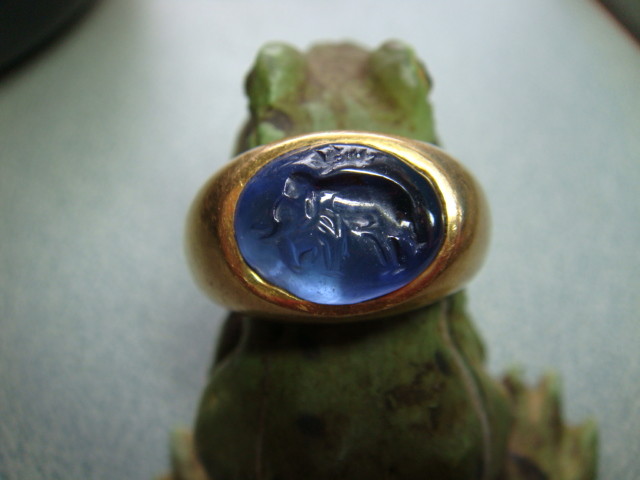
Finally there is the elephant memory which I wear. The Perahera in Sri Lanka where a parade of up to 100 elephants dressed in mirrored satin and gemstones with gold rings on their ivory tusks are ridden by men beneath the bearers of umbrellas. The lead elephant, the largest carries a chest on his back which contains the sacred tooth relic of the Buddha. I have that image of that elephant from the Parahera carved as an intaglio in  blue sapphire which was panned from the gem gravels in a stream near Ratnapura. I took it in trade from a Muslim gem dealer who had no interest in Buddhist artifacts. I mounted it in 22 karat gold ring. It is ancient.
Its origins are completely unknown.

Saturday, February 5, 2011

Making Fire

It is said that Prometheus defied the gods and stole fire as a gift to men. For this he was severely punished by being chained to a rock and having his liver torn out and eaten by an eagle everyday. Gods are never pleased when mere mortals usurp their power. Fire is the element that ends the life of the phoenix consuming him in a pile of ashes, and is the same power which  resurrects him to a new life. Light is defined and separated from the darkness by fire, illuminating, silhouetting and expelling hungry carnivorous animals lurking at the porphyry of the unseen. Fire drives away evil spirits from a community and from the imaginations of men.
Two million years ago a strike of lightening may have hit a tree or a dry bush, perhaps a volcano erupted and allowed paleolithic man to capture that stunning power and bring it home like a treasure. Who was that genius who recognized the power of fire?
Power to be warm in the cold, power to distinguish your neighbors at night from your foes. Power to burn down your enemies settlements and steal their wives and goods. Fire to cook your meat to a crispy sizzling brown rather than that same old bloody raw carpaccio.
So if your Zippo looses it's flame, your box of matches has gone soggy, and you just can't wait for that next strike of lightening, or for that rumbling volcano near you to explode, teeth chattering in the darkness, here is your solution brought to you by the Samburu tribe of Kenya and Tanzania. Home made portable, all purpose Fire.
Try some today!

Sunday, January 30, 2011

The Strand Hotel


In 2003, a book was published by Andreas Augustin simply called "The Strand Yangon". At the newly renovated bar he asked me what it was like staying there at the faded beauty years ago. The opening of the Suez Canal  in 1869 made travel to Asia far easier and thousands of miles shorter. It was the age of opulent travel, steamer trunks and servants. The Sarkis brothers had already opened the Raffles in Singapore and the Eastern-Oriental in Penang. They were to open the Strand in Rangoon 1901.
When I first stayed  there in the early 1980's the Strand was entered through a thick beat-up side door just down the street from the Military Intelligence building.  A well worn check-in desk polished by the historical elbows of the wealthy welcomed me. A telephone operator in a tight patterned sarong sat behind pulling out and plugging in red and black wires from the antique switchboard. The lobby was paved with black and white marble squares, all that was missing were the chessmen. Overhead fans swirled with wooden blades the size of which flew Lindburg over the Atlantic. At the long solid mahogany bar with local rum and gin, Mandalay Beer was served by dark Indian waiters in frayed collars and waxy scented oiled hair. You could feel the ghosts of gentlemen and elegantly dressed women from bygone era. Across the empty lobby was an Otis elevator made of polished brass piloted by a smiling midget, standing well below the levers, controlling by hand where the car stopped , sliding the grate open and closed, usually a foot higher or lower than the actual floor you intended. Legions of arrogant bats flew down the hallways and the occasional rat lurked in the shadows watching which room you were checked into for further reference.
The room itself had a Victorian desk and chair. Each of the legs on your bed stood in a powdery mound of deathly bug killer to insure the creepy crawlies didn't scurry up and sleep with you. On one wall a framed mirror hung with a spiderweb of black, missing the reflective silver, in front of which you swiveled your head enabling you to see only portions of your whole face. The bathroom had a rain shower as big as a dinner plate, where if the water by chance did flow it was intermittently either cold or scalding hot but always without fail, a rusty orange. The toilet had a pull cord with a tank of water overhead. A room was about $25 dollars and the sheets smelled of tropical mold and the last sweat drenched occupants. The best food in town was served downstairs. The restaurant cooked huge lobster thermidor whose tails and legs spilled over the edges of your dish for $3 dollars.


Some of the most intense days of my occupancy were during the uprising of March1988. Sitting in my recessed window sill looking through the old swirly glass on to Strand Road below, across from the jetty and the Rangoon River, tanks occasionally rolled by and dozens of canvas covered trucks carrying young soldiers hefting ancient machine guns, G-2's and G-3's, jumped from the back and fired down the street at protesters who scrambled through clouds of tear gas to avoid getting shot. Many were shot. Here at night was a major capital city in a country the size of France, standing silent, no movement, vacated, deserted, eerie.
In the morning, I was greeted by the leathery doorman, "Good morning sir", as if all were just peaches and walked out into the street which was congested with hustlers, skimmers, scammers and shammers. The only market as usual was the black market.There were gem dealers, antique steelers, pineapple peelers, and money changers all desperate, hovering around watching, waiting, steeped in crimes and intrigue. More violence was expected, people were in the streets, angry. Spies were everywhere, who was who? Who was watching you? I don't know, I would never know, but the eyes would burn like lasers. I hit the streets with discretion and tried to avoid the expected uprising.
Shortly after this any foreigners still in the country left voluntarily or were dispelled. Martial law and the curfew would be declared in June 1988. Soon Burma closed its doors to the world. The Grande Dame was left completely vacant of guests until 1989 when I along with a trickle of foreigners on group tours were once again allowed into the country and into the hotel to breathe her musty history.

Wednesday, January 19, 2011

New Year of the Headhunters

While compiling photos and stories of unexplored areas of Burma to complete my book which would become titled "The Vanishing Tribes of Burma", I knew that there was still one very important area in the north-west to visit. Nagaland.
Nagaland had been off limits for 50 years, and the last comprehensive book on the Nagas, "The Naked Nagas", by Christoher Von Furer Heimendorf  had been published in 1939. The Naga, confirmed headhunters, were, and probably still are, in the remote Patkai Bum range of mountains. Naga tribes live in both India and Burma and travel back and forth as they wish. Nothing is more troublesome to central governments than groups of nomadic hill tribes who pack up and move at will. Porous borders, far away from any government control mean nothing to the Naga since they have no national identity, only that of kinship with their own tribe or clan.
I had been in contact with the Naga Cultural Committee since March 1996 through my friend the Bishop of Myitkyina, Bishop Paul Grawng, I  had received word that they were expecting me to join them for Naga New Year in January 1997.
Getting an air ticket issued in Rangoon to Singkaling Hkamti the closest airport to the Naga Hills was impossible. As time was beginning to run out, I flew to Mandalay and with a bit of help, and a new crisp $100 dollar bill, I was issued a ticket. The land route was not possible and even on modern maps Singkaling Hkamti was shown without the airstrip at which I would be landing. As far as I knew, I would be the first foreigner to ever witness the New Year event. In Mandalay, two immigration officials and one military intelligence man in dark Ray Ban's joined me and said that they would "help me to get aboard".
The flight was 1 hour and 20 minutes and we touched down in the small plane on a dirt runway raising clouds of dust behind us.
Singkaling Hkamti is on the Chindwin River just a few days hike to India. By now it became clear that the immigration guys had been assigned to me, to follow me where ever I went and to make sure I didn't just wander away in to the hills and disappear. I accepted the arrangement and told them that if they were going to follow me that they should at least carry my heavy camera bag and they did. Hell I was older than them, I'd been at this a long time.
We checked in at a guesthouse in town where I had my first glimpse of Naga girls, each with several vertical tattoos from their lower lip to their chin, and a hooked diamond shaped tattoo on their foreheads. The immigration guys were at the guesthouse napping, so I gestured to the curious girls and invited them to join me in a beer bar down the road. It was a dark place where we took a wooden booth and pulled the curtains shut. The waitress brought 3 chilled beers and pulled the red curtains closed. These Naga girls lived in town and were sweet and playful. I traced the ink in their tattoos with my fingers and we laughed and drank beers.
After frolicking with them for some time, I gave one of them my cheap watch, and stumbled back to the guesthouse.
The next morning I woke up my escorts, immigration who camped outside my door, and we walked up a hill to a Naga Morung or men's house, with totems lined with animal skulls. Only a short time before these skulls would have been human. 
As we walked higher up the path to the west, there was in the distance a low monotonous sound of grunting punctuated by high pitched screaming and rhythmic singing. As the sounds became louder we sensed that they were coming our way, so we stood frozen at the side of the trail. Over a crest of the hill came about 60 Naga warriors running with ox-leather shields and long spears covered in dyed red goat fur which they raised in unison. They wore woven-rattan hats, some with designs in red and yellow, circled with black monkey fur draped with wild boar tusks hanging over their eyebrows. Each hat was topped with long black and white hornbill feathers rising up from the center. Some warriors had their chins and jaws ringed in tiger claws. Around their necks they wore red beads and tiger teeth. These men were elegant and lithe, with the finely carved muscles of athletes. As they ran past, singing and screaming, I thought that the last time any foreingers had seen such an amazing spectacle, had their ears singed by these war chants, they were about to ceremonously lose their heads. The Naga were coming down from the hills.
All through the day and into the evening, hundreds of men and women from Kuki, Layshi, Lahe and distant mountains came in all directions.
I spent the rest of the day with the Naga Cultural Committee and photographed. The committee members told me that there were to be sacrifices beginning at 3a.m as a necessary cleansing ceremony for the ground on which the festival would be held, and that I would be the first foreigner to ever witness the event. Shortly before 3a.m, the committee leaders came to wake me and my immigration men and we all walked uphill toward the festival grounds in the cold January darkness.
At the festival ground a blazing fire was fed by whole logs. The Naga led a docile buffalo with enormous horns, several squealing pigs and many chickens. The buffalo was tied in place , and wedged his legs into a bamboo lattice with a rope over his head, and through his nostrils which were belching steam. The Naga began to sing and chant, dancing around the rising flames and punctuated the silent night with screams. As the animal's chest began to heave in fear, a Naga chief in a black and red robe whispered into the buffalo's ear, asking him to die willingly and peacefully, and blessed him with kongye, a milky rice beer. One warrior silently removed his dah, a long knife with sharpened edges and with one swift stroke chopped through the tendons at the back of the animals legs so he could not jump. the buffalo's shock and agony were short-lived as another warrior plunged a long spear into his heart.
I was asked by the committee members  to don a hat and black and red blanket with cowry shells and give a testimonial  to the Naga for their New Years celebration. In a short speech which was translated I thanked them for their invitation and hospitality and we toasted with my scotch and their kongye.
Early the next morning at the festival ground the kongye began to flow again and I was given a chair a the front table with the Naga councillors.
I remembered a story that one of the priests from Myitkyina had told me about the time he had brought a group of Konyak Naga girls to Mandalay.
"You must wear T-shirts", he had told them. "You cannot go in to town naked".
"But the T-shirts itch", they protested. "We cannot wear them".
"You must wear them when we are in town", the priest insisted.
The next day, the priest went to collect the girls for the sightseeing trip around Mandalay. They were wearing the T-shirts he had given them with a picture of Pope John II on the front, but they had cut holes for their breasts to poke through on each side of the pontiff's head.
At the celebration, Naga girls who were not topless continually poured kongye into the hollow lenghts of bamboo we were given as cups. By now all of the Naga groups had arrived, the Hunimya, the Makhury, the Naukawe, the Kuki, and the Lai Nawg. The Tanghkul and Kohyak Naga were absent, perhaps in the case of the Konyak, because of the government's requirement for them to wear clothes, as they would never do.
The Naga assembled and danced, some in monkey fur leggings and black blankets with red squares. Some had thick ivory bands from elephant tusks worn around their arms. Hundreds marched around shouting,
"Wow wah, wow wah" while beating their leather shields against their legs and screaming shrill war cries. Some shouted "Ah hay" which was high praise. Girls served pork, chicken and beef with wild mushrooms and sticky rice wrapped in banana leaves.
The feasing and drinking, dancing and singing continued all day and into the night, with different groups performing. Some of the girls were flirtatious, while other were shy. Girls of the Kuki Naga wore huge tufts of white fur in their ears, with strands of dyed-red goat fur nearly touching their shoulders. Some of the songs and dances were of war and triumph, when the villagers would welcome the warriors back home with the trophies of human heads they had taken in raids on other clans. Several of the warriors now dancing around the fire wore long strands of human hair from their ears.
This practice had supposedly been stopped, but I had heard of heads being taken in raids as little as three years before. And now, in the Patkai Bum range and the Angpawng Bum northwest of here, who really knew?


There seemed to be no taboos regarding sexual relations between boys and girls and many wandered off into the bushes. Late at night, when everyone had drunk their share of kongye, fist-fights broke out, and some of the girls could be seen carrying their drunken menfolk away on their backs, not really struggling under the weight, but staggering nonetheless, silhouetted against the moonlight.
Unfortunately something this good could not last. It didn't. Naga New Year today is a correographed  stage show with tour guides in Rangoon charging $1,500 U.S.Dollars per person to a throng of tourists probably outnumbering the Naga, who are allowed to attend for only one day, and take pictures of the backs of each others heads.

Tuesday, January 11, 2011

Phantom of the Apocalypse

 
With the death this week of General Vang Pao I was reminded of another warrior who I knew and photographed in the early 1990's. Tony Poshepny aka Tony Poe worked together with Vang Pao as an advisor and was dropped behind enemy lines to conduct a secret war and stop the North Vietnamese march in to Laos. Poe who was a marine in 1942 fought on Iwo Jima recieving two purple hearts. He would earn five in his lifetime. In 1951 he joined what was to become the C.I.A and won the C.I.A Star twice. He ran sabotage teams  behind enemy lines in Korea while smuggling weapons and training Chiang Kai-Shek's Chinese Nationalist Army which was attempting to overthrow the communists in Peking.
In 1958 Poe and fellow C.I.A operative Pat Landry tried to overthrow President Sukarno in Indonesia. Outgunned and trapped on the island of Sumatra, they fled 150 kilometers through the jungle to escape, caught a fishing trawler and were rescued by a U.S submarine.
He then trained  the fierce Tibetan Khamba tribesmen to help the Dalai Lama flee Lhasa which was being surrounded by communist Chinese in 1959.
 In 1961 he began C.I.A work in Laos during America's "secret war" against communist North Vietnam and the Pathet Lao. Liaising with General Vang Pao he was able to recruit thousands of Hmong tribal warriors who he rewarded for bringing in enemy ears. He put human heads on stakes around his encampment to terrify the enemy along with strings of ears on his porch.
In the capital of Laos, Vientiane, the U.S Ambassador doubted his body count so Poe sent and envelop with human ears stapled inside making a young secretary who opened it vomit. he hurled human heads from low flying aircraft on to his communist enemies one of which was known to have bounced in the guy's front door.
Tony Poe became a jungle warlord revered by thousands of Hmong warriors. Against all C.I.A protocol he married a local Hmong princess with hair down to her ankles named Seng La who was the niece of Touby Lyfoung one of the kings of opium. According to Jack Shirley he sent a cable to the C.I.A, "I'm married...she's mean as hell...speaks no language...doesn't smell too good...but she's mine now"..
In one aborted attempt to kill Poe two of his fingers were blown up, they could have been saved but he tore them off and threw them in the bushes.
During the entire "secret war" in Laos 2.5 million tons of bombs were dropped making Laos the most heavily bombed country in the world.
Poe may have been the inspiration for Col. Kurtz played by Marlon Brando in Francis Ford Coppola's film "Apocalypse Now". He was a hard drinking renegade who drank a quart of Lao Kao, homemade whisky every morning before emerging from his hut to launch assaults on the Chinese. At night he would hurl drunken abuse about the C.I.A and the U.S Ambassador on a radio link.
After ten years in the jungle Poe refused to go home. In the early 1970's the North Vietnamese, the Pathet Lao, the Chinese, and the Americans all wanted him dead. Everyone wanted and tried according to Jack Shirley to terminate his command. After the stapled ears incident the Ambassador ordered him out. "Come up and get me you big prick:, said Poe
The C.I.A finally pulled him out of Laos in 1970. The U.S were withdrawing and a frustrated and raving drunk Poe showed up at the Ambassador's office in Vientiane with a rifle in one hand and a machete in the other. In 1973 his base at Nam Yu was bombed completely off the map by B-52' piloted by the C.I.A. In 1975 Poe disappeared but wound up on the Thai-Lao border town of Udon Thani sometimes venturing to Bangkok where I first met him. In the early 1980's he swaggered around Udon Thani with his pistols and brawled. Because of the  respect he had earned in Laos, the Thai police tolerated him but fearing his violent drunken outbursts, he was escorted to the airport in Bangkok and in early 1990's given a one way ticket out.
I took this photo of Tony Poe  in his house on Wawona St. in San Francisco. Inside the frame he is holding is the C.I.A insignia with two of his purple hearts and medals from foreign kings.


Friday, January 7, 2011

Gem Freak

And now for something completely different. What I want to show you is a very rare geological freak of nature.
The photos are of a natural, unheated, untreated  sapphire from Mogok, Burma. I bought this stone some years ago and keep it in my collection. Gem photography is notoriously difficult dealing with the effects of light in a 3 dimensional object. Reflection, refraction, dispersion, saturation and angle of incidence. Mogok produces the finest Ruby and Sapphire in the world. Always has. Gems have been mined there since antiquity and were mentioned by Marco Polo in his "Travels" 800 years ago. Paleolithic tools have been found there. A natural untreated Mogok Ruby of 7.04 carats just sold in Hong Hong for $2,979,128 U.S Dollars, or 430,000 Dollars per carat. Whoa.


There are stones which change in color in different sources of light. Royal blue in florescent daylight changing to a reddish violet under incandescent electric light. These stones are known as change of color Sapphires. This stone however is 2 colors in any light. It is properly called a bi-colored Sapphire. The stone was bought in Mogok by a gem dealer friend of mine in the rough directly from the muddy earth. He is an expert cutter and cut this stone in a cushion shape to exhibit the rich blue edges with a pinkish purple stripe down the center. It is as you can see from the certificate 3.62 carats. Gem dealers who have seen this stone say that in all of their years in the gem business they have never come across such a rare stone as this, half Sapphire and half Ruby. A true gemological freak.